Nobody Told the Referee What Language to Yell In
Chapter 1 | The Bar in Dallas

How the 2026 World Cup became the world's most chaotic, beautiful, accidental language lesson
Chapter One
The Bar in Dallas
Watch the Scene
Click to watch on YouTube
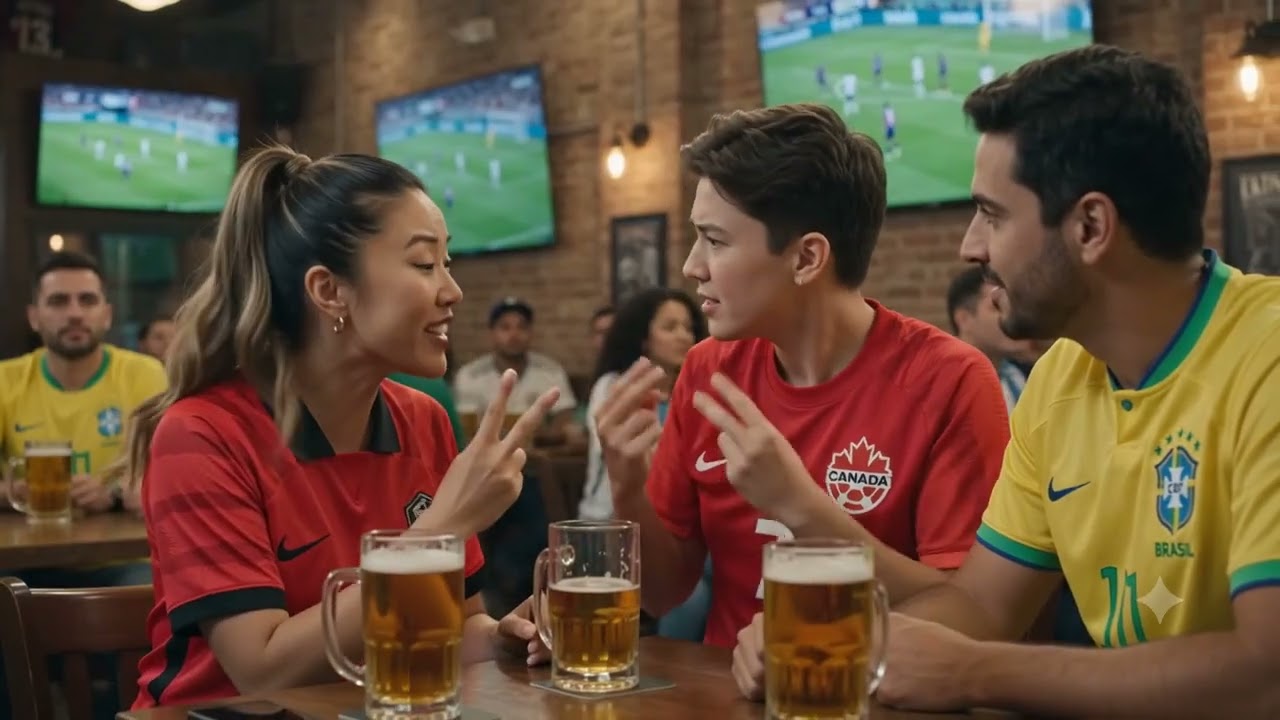
It is Thursday evening, somewhere in Deep Ellum, Dallas, and the bar has no business fitting this many nations under one roof. I count four languages in the booth behind me before the first whistle blows. There is a family from Seoul to my left, the father translating the menu with his phone pointed at the laminated card like a flashlight. To my right, three guys in green-and-white Nigeria jerseys are arguing about something with the intensity of a presidential debate, and from the cadence of it I suspect the argument is not about soccer at all. Two rows back, a man in a Canarinha shirt, the brilliant yellow of Brazil, is standing even though there are empty seats, because some people watch soccer standing up and that is simply who they are.
And then there is the French-Canadian.
I will not pretend I caught his name. I will tell you that he had opinions, delivered in a mixture of Quebecois French and English that arrived at the ear like a blender set to medium, and that his primary opinion was about the Mexican fan three seats over who had just announced, with total confidence, that the last call was not offside. The French-Canadian disagreed. The Mexican disagreed with the disagreement. I watched them argue for four full minutes in two languages with the enthusiasm of people who had known each other for years.
This, I kept thinking, is the thing that nobody's travel guide prepares you for. You spend weeks studying the host cities. You read about Dallas and Houston and Los Angeles and New York, about Guadalajara and Monterrey and Vancouver and Toronto. You read about language barriers and cultural differences and the importance of knowing a few words in the local dialect before you land. All of it true. All of it, in that bar on Thursday evening, completely beside the point.
Final score, Thursday evening, the bar in Dallas. Everyone tied.
Nobody won. Nobody lost. The bar kept its liquor license.

While fans in bars across Dallas were working out their own multilingual diplomacy just fine, FIFA was having a harder time of it in the press room.
Ahead of Morocco versus Brazil at New Jersey Stadium, a journalist from Mexico's TV Azteca attempted to ask Morocco captain Achraf Hakimi a question in Spanish. Hakimi, who was born in Madrid and speaks Spanish, Arabic, French, and English, was ready to answer. A FIFA press official stopped the exchange. Spanish was not available. Only English and the official languages of the competing teams were permitted. In this case, those were Arabic and Portuguese.
Hakimi turned to the official, patient and polite: "How should I reply, in English or Spanish?" He answered in English. The clip went viral within hours.
One of the three host nations of this tournament is Mexico. Mexico speaks Spanish. FIFA had not planned for this.
A similar scene followed with Vinicius Jr. of Brazil, who encouraged a journalist to continue in Spanish before officials intervened. Then again with Netherlands midfielder Frenkie de Jong. The internet, as the internet does, had opinions. "What a weird idea," one fan wrote, "not to allow questions in the language of one of the hosting countries."
Within 24 hours, FIFA reversed its policy. Spanish interpretation would now be available at all press conferences for the remainder of the tournament.
Nobody told FIFA what language to hold a World Cup in, either. Turns out that matters.
The 2026 World Cup did not create this multilingual continent. It simply turned up the volume on something that was already playing.
The United States has no federally declared official language. More than 350 languages are spoken in American households right now, today, while you read this. Mexico officially recognizes 68 national languages, not counting hundreds of regional dialect variations. Canada operates in English and French and also in Punjabi, Mandarin, Cantonese, Cree, Inuktitut, and the particular dialect of hockey enthusiasm that transcends all of the above. The 2026 World Cup did not create this multilingual continent. It simply turned up the volume on something that was already playing.
I travel for a living, or something close to a living, and I have been in rooms like that Dallas bar before. In Florianopolis, in a waterfront cafe where a Brazilian fisherman explained the entire history of the city to me in Portuguese while I understood maybe forty percent and nodded at what I hoped were the right moments. In airports where the gate announcement comes in four languages and the fifth language, the one you actually speak, is notably absent. Travel has a way of reminding you that language is a tool, and like any tool, what matters is not which one you are holding but whether you know what you are trying to build.
In that bar, nobody was trying to build anything complicated. They were trying to watch a soccer match and have opinions about it, loudly, in the company of strangers. And somehow, beautifully, that was enough.
But I kept asking myself a question that the scoreboard could not answer. We were all speaking something in that room. We were communicating, clearly, efficiently, with feeling. What exactly was the language?
We will get to that. First, I need to tell you about the referee.
The bar handles itself. The documents are another story. If you need certified translation for travel paperwork, visa applications, or anything that requires a professional human to get it right, The Spanish Group works across more than 90 languages and has been my go-to for exactly that kind of thing.
Certified & Notarized Translations (Idiomatic)Affiliate link, I may earn a commission at no extra cost to you.

Comments
Post a Comment